
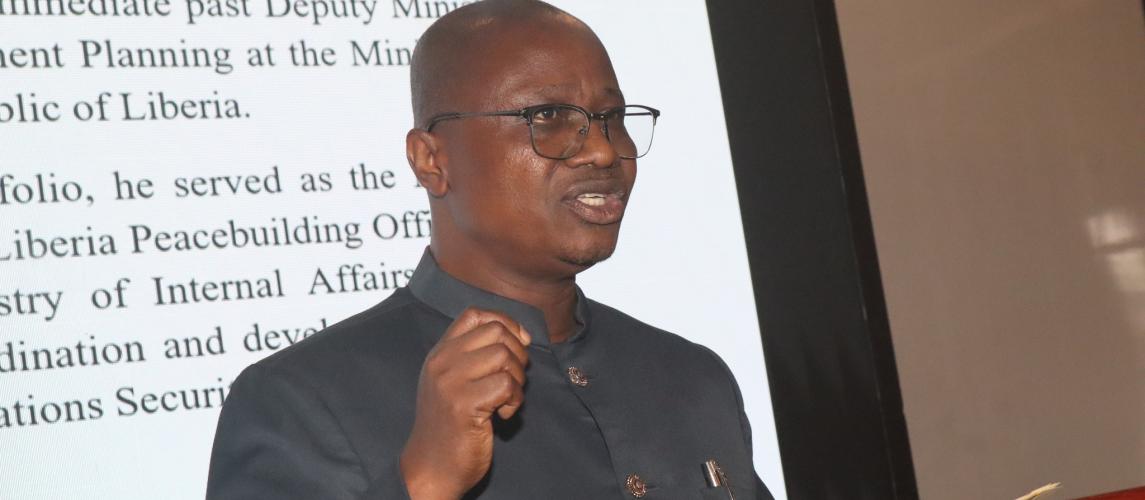
Deputy Minister Designate for Local Government and Decentralization - Hon. Edward K. Mulbah
Official statement by: Edward K. Mulbah; Deputy Minister for Local Government and Decentralization (MLG) at the 3rd Annual Summit: “Sustaining Liberia’s Democracy through Accountability
3rd Summit for Democracy and Political Accountability in Liberia: Sustaining Liberia Liberia’s Democracy through Accountability, Inclusion, and Rule of Law - Deputy Minister Designate for Local Government and Decentralization - Hon. Edward K. Mulbah; Ministry of Local Government
March 24, 2026
Officials of Government here present, Development Partners, UN, Director and management of Naymote Partners for Democratic Development, our young people, ladies and gentlemen:
I am deeply honored for the invitation to participate in this 26th Summit for Democracy and Political Accountability in Liberia.
I extend heartfelt appreciation to the young people who continue to demonstrate confidence and trust in the ability of this Government to bring change – a change that will impact their lives positively. I also thank the funding partners, especially the Embassy of Sweden for standing with this government and for the financial support to this Program. As we have been invited to his program to serve as Special Guest, we believe it is an exceptional honor. My contribution to the dialogue on strengthening democratic governance, promoting accountability, and advancing inclusive and people-centered local administration will focus on decentralization, coordination and local governance.
With that said, let me inform you that the Ministry for Local Government and Decentralization, the newly established Ministry better placed to promote the central theme of this Dialogue - that is strengthening democratic governance, promoting accountability, and advancing inclusive and people-centered local administration.
To achieve this strategic objective, the work of the Ministry is guided by three strategic legal frameworks:
-
The Local Government Act of 2018 – emphasizes participation, inclusive governance, participatory planning and service delivery.
-
The Revenue Sharing Law of 2022 – is about sharing revenue based on modalities of best practice between local and central governments, generating revenues to finance local development and creating public trust rooted in citizens’ satisfaction and real-time access to quality services.
-
The Ministry of Local Government Law 2025 – ensures stronger coordination and collaboration between local government authorities and central government institutions.
These laws provide the institutional foundation for bringing governance closer to the Liberian people, thereby addressing one of Liberia’s major conflict factors.
Decentralization
Now let’s look at Decentralization, and how that applies to local government?
It's about transferring of authority and responsibility for public functions from the central government to the county governments or to quasi-independent government organizations or to the private sector. There are different forms of decentralization, depending on the nature of the responsibilities that are being decentralized. These include:
-
Deconcentration. The transfer of authority, responsibility, and resources from the central government to County administrations of the central government ministries, agencies and commissions, e.g. County Service Centers – actors in these centers are accountable to their central government authorities. [Decisions are centralized].
-
Delegation. The transfer of authority, responsibility, and resources from the central government to semi-autonomous corporations and these corporations are ultimately accountable to the central government.
-
Devolution. The transfer of authority, responsibility, and resources from the central government to the local governments. This is the thrust of decentralization – signatures, decision-making and services must be decentralized. Accountability, democratic governance, ownership.
In addition to these forms of decentralization, decentralization has three dimensions:
-
Political dimension. The transfer of political authority and oversight responsibility from the central government to citizens or their elected representatives at the local level. This is to give citizens, or their representatives, more influence in the formulation and implementation of laws and policies. – this promotes local governance and allow citizens to participate in the creation of laws, enforce rules and citizens are obliged to obey rules.
-
Administrative dimension. The transfer of administrative authority and responsibility that involves the transfer of responsibility such as planning, financing, and management of certain public functions from the central government and its agencies to Local governments.
-
Fiscal dimension. The transfer of fiscal authority and responsibility as well as financial resources from the central government to the quasi-independent subnational governments.
Related to these dimensions, we have made some progress by the establishment of local government structures, including, County Councils, responsible for approval of annual local government budgets and plans: Promulgate laws, ordinances and ensure collection of revenues through taxations, etc; Established County Development Planning Units to facilitate inclusive planning processes, monitoring, evaluation and reporting on transferred responsibilities and resources. Accountability, democratic governance and peopled-center decision makings are derived through these processes.
Despite the progress, Common Challenges persist …
Slow pace at which power and authority are being transferred to local governments – Heads of relevant decentralization related MACs are still holding on to power and functions in Monrovia – creating bottlenecks for decentralization to actually work. This is recipe to undermine the concept of decentralization, and slow down local development programs and initiatives.
Local government structures lack the skills and technical capacity to adequately manage devolved/delegated authority, and responsibility that should be transferred to them. Inadequate institutional capacities and infrastructure – County Service Centers and County treasuries do not have adequate operating environment to effectively function – buildings, logistics and resources.
Diverse concepts of district. Districts are the entry points for Liberia’s development. But we have multiple ideas of districts - political, administrative, statutory, health, agriculture, education; all these undermine development outcomes across districts. We need to recognize what the law says about districts. It states that by 2025, all administrative districts would have been dissolved, and the employees retired. – Electoral districts for elections, administrative district. MACs need to ascribe to the Law about districts, not to create health, Agriculture, Education, etc districts.
Coordination and Local Government
Decentralization in local government is most effective when it bridges authority with responsibility. The goal is to bring decision-making closer to citizens to improve service delivery and responsiveness.
Decentralization is often the "engine" of grassroots democracy that fosters accountability and builds trust in governance systems.
For Decentralization to succeed in Liberia, we need to:
-
Strengthen coordination at both central and local levels – the different coordination mechanisms, such as the IMCDM, TWG, county-level coordination meetings and other must be able to work
-
Improve sector Coordination at both Central and Local Levels to enhance service delivery, avoid duplication, prevent resource wastage and strengthen complementarity (LACE, MoH, MoE, MoA, MM&E, NHA, FDA, EPA, and MLG, etc).
-
Ensure participatory planning, which is very important – it involves residents in annual planning of community projects, such as deciding which infrastructure projects to prioritize for the benefit of the citizens.
-
Clearly and practically appreciate the roles for the different levels of local government structures and ensure adequate, secure funding for them to function in keeping with their mandates"
-
Invest in training, technical support, and institutional capacity building to ensure local officials can handle their new responsibilities effectively.
-
Empower local authorities to generate revenues through taxation and to manage their own budgeting for better accountability.
-
Implement regular evaluations to assess performances of these local government structures, ensuring local actions remain aligned with the central government development agenda.
-
Invest in training for local officials in technical areas like public financial management and effective project oversight and accountability.
-
Constantly engage local communities, marginalized groups, and NGOs in the planning processes to encourage accountability and transparency.
-
Adopt a phased-based, gradual approach to decentralization to allow capacity-building to catch up with devolved responsibilities. “Not one size fit all approach”
-
Recognize that not all regions are the same; use flexible, tailored-made arrangements where different regions receive different levels of autonomy based on their capacity
If we implement the different forms and dimensions of decentralization, we’ll definitely be strengthening democratic governance, promoting accountability, and advancing inclusive and people-centered local administrations.
I thank you
